
|
Home | ||
Junagarh Fort |
|
 Built in 1593 AD by Raja Rai Singh, a general in the army of Emperor Akbar, Junagarh is unusual because unlike other major forts which are built on hill tops, it was built on the desert plains itself. A formidable structure encircled by a moat it has some beautiful palaces within. The Suraj Pol or Sun Gate is the main entrance to the fort.
 The main entrance to the fort is Karan Pol [gate], that is east facing. Next to it is the Suraj Pol meaning the sun gate. The fort situates in it some very magnificent palaces like Anup Mahal, Ganga Niwas and Rang Mahal or palace of pleasure. The Har Mandir is the majestic chapel for the royal family for worshipping their gods and goddesses. These palaces, constructed in red sandstone and marble, make a picturesque ensemble of courtyards, balconies, kiosks and windows dotted all over the structure. The premises also houses a museum which is an array of a rich collection . |
|
Lallgarh Palace |
Top^ |
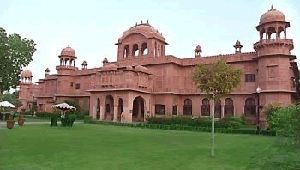 Lal Garh Palace built by Maharaja Ganga Singh in the memory of his father, Maharaja Lal Singh, the red palace with overhanging balconies and lattice work make it an imposing structure. Sprawling lawns with blooming bougainvillea and dancing peacocks render it a breathtaking visual treat. Part of the palace has been converted into a luxury hotel and a museum, Shri Sadul Museum.
This grand palace is an architectural masterwork in red sandstone, and was built by Maharaja Ganga Singh Ji in the memory of his father Maharaja Lal Singh Ji in 1902. Sir Swinton Jacob designed this oriental fantasy. This architecture is a fusion of Rajput, Mughal and European architecture. The exterior contrasts dramatically with the oriental interiors and amenities. The palace has beautiful latticework and filigree work, which are hallmarks of a great craftsmanship. The Palace has an amazing collection of well-maintained paintings and hunting trophies. Sprawling lawns with blooming bougainvillea and dancing peacocks make a visual extravagance. |
|
Gajner Palace |
Top^ |
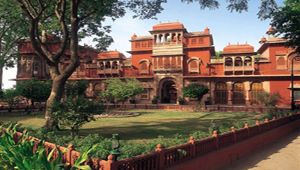 Gajner Palace is a very best resort of Bikaner Maharajas -has often been described as ' an incomparable jewel in the Thar desert'. Built by Maharaja Ganga Singh ji of Bikaner, palace stands on the embankment of a lake .The palace was used by Maharaja for grand shoots and lavish entertainment. Royalty, Indian as well as international, Viceroys and other dignitaries have been entertained at this grand palace. The architecture of Gajner palace is truly outstanding.
 |
|
Karni Mata Temple (Rats temple) |
Top^ |
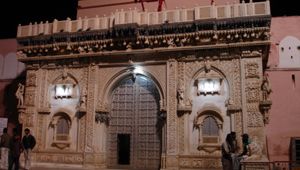 This 600 year old temple is dedicated to Karni Mata, a famous mystic of her times, believed to be an incarnation of goddess Durga. Legend has it, that she foretold the victory of Rao Bika. Here, rats are considered holy, owing to the belief, that the souls of the devotees of the Mata, are resident in these rats and, consequently, they must be looked after. The huge silver gates to the temple, and the marble carvings were donated by Maharaja Ganga Singh. This 600 year old temple is dedicated to Karni Mata, a famous mystic of her times, believed to be an incarnation of goddess Durga. Legend has it, that she foretold the victory of Rao Bika. Here, rats are considered holy, owing to the belief, that the souls of the devotees of the Mata, are resident in these rats and, consequently, they must be looked after. The huge silver gates to the temple, and the marble carvings were donated by Maharaja Ganga Singh.People from far and wide come to pay religious tribute to shri karni mata. Throughout the year there's an influx of pilgrims. Outside rajasthan, places like Gujrat, Madhya Pradesh, Haryana are areas where mata is greatly respected and loved. During the time of navratri thousands flock to mata's temple on foot. Mata's enigma attracts pilgrims from all over. It is becoming one of the holiest and most faithful places in India. |
|
Bhandeshwar and Sandeshwar Temples |
Top^ |
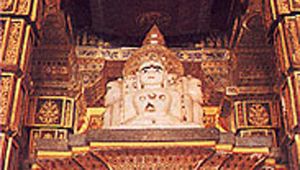 These Jain temples were built by two brothers and named after them-the Bhandeshwar temple-rich in mirror work and the Sandeshwar temple-stylized enamel and gold leaf wall paintings. The temples are dedicated to 23rd Jain teerthankar, Parsvanathji. These Jain temples were built by two brothers and named after them-the Bhandeshwar temple-rich in mirror work and the Sandeshwar temple-stylized enamel and gold leaf wall paintings. The temples are dedicated to 23rd Jain teerthankar, Parsvanathji. |
|
Shiv Bari Temple |
Top^ |
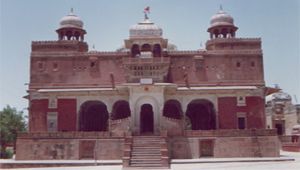 Be captivated with the ethereal charm exuded by the delightful Shiv Bari Temple that is located at a distance of 6 kilometers from the main Bikaner city.
Constructed by Maharaja Doongar Singhji, the Shiv Bari Temple in Bikaner, Rajasthan, India is a virtual museum of miniature paintings that are delicate yet colorful representations of ethnic Bikaner traditions and patterns. See the splendid domes, sculpted columns and the stunning pavilions that adorn the lovely Shiv Bari Temple in Bikaner, Rajasthan, India. The Shiv Bari Temple in Bikaner is referred to as the Laleshwar Mahadeo Temple by the locals and is famous for its massive statue of Lord Shiva in black marble. There are two massive stone reservoirs located within the Shiv Bari Temple premises that definitely capture your attention and give you a fair idea of the importance of water in the region. |
|
Bhaironji Temple |
Top^ |
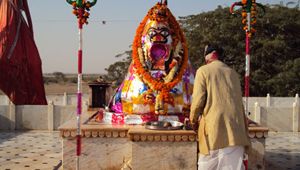 The Bhairon Vilas Palace hotel in Bikaner is one of the best examples of Rajput architecture. Built in the year 1872, it was also the personal residence of Maharaja Bhairon Singh Ji. Bhairon Vilas in Bikaner has always been in the news for the Bhairon temple. This Haveli has already been a landmark because many dignitaries have visited this wonderful work of art. Almost all the Viceroys and Governor Generals of India have visited this place.
 |
|
Ganga Singh Museum |
Top^ |
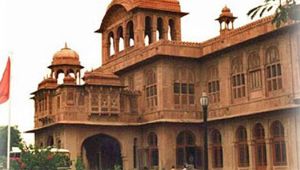 The exhibits here are splendid masterpieces of Harappan civilisation, Gupta and Kushan era and sculptures of the earlier eras. On display are terra-cotta ware, weapons, miniature paintings of the Bikaner school and coins, making it one of the best museums of Rajasthan. Bhandasar Jain Temple (5 km) Beautiful 16th century AD Jain temple dedicated to the 23rd Trithankara, Parsavanathji.
 |
|
Sun Gate |
Top^ |
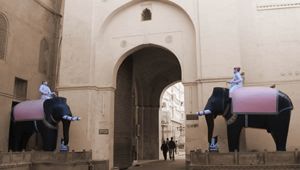 Suraj Pol or Sun Gate is the main entrance to the Junagarh Fort. The fort is encircled by a moat that protects the splendid complex of thirty-seven palaces, pavilions and temples added by different rulers, the last one, as recently as 1943. Their lavishly adorned interiors are much better preserved than those in any other palace in the region. Suraj Pol or Sun Gate is the main entrance to the Junagarh Fort. The fort is encircled by a moat that protects the splendid complex of thirty-seven palaces, pavilions and temples added by different rulers, the last one, as recently as 1943. Their lavishly adorned interiors are much better preserved than those in any other palace in the region. |
|
Kalibangan |
Top^ |
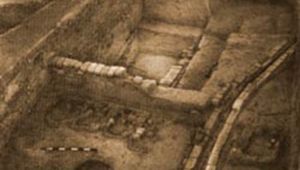 Admire historic ruins at Kalibangan on your excursions from Bikaner with Indian Horizons. Kalibangan is of immense historical importance as it was an important part of the ancient Indus Valley Civilization that flourished in between 3000 B.C. to 5000 B.C.
The ruins at Kalibangan, Bikaner give evidence about pre-Harappan and Harappan civilizations and also contains evidences of how the Harappan civilization evolved from the pre-Harappan civilization. Delight in the thrilling experience of unearthing historical secrets that intrigue your curiosity. |
|
Shri Sadul Museum |
Top^ |
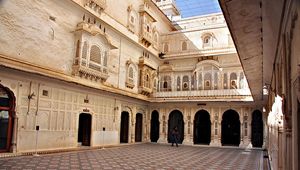 Shri Sadul Museum is located at Lalgarh Palace, the red sandstone palace located in Bikaner. It is housed in the Ganga Niwas, which covers the entire first floor of the palace.
The museum displays a unique collection of miniature paintings, manuscripts, weaponry and old photos depicting royal hunts. It also houses the personal possessions of former Bikaner rulers, which includes golf tees, camera, clothes, books and earplugs.
The museum is open daily from 10:00 to 17:00 hrs, except on Wednesdays. It can be visited on a small entrance fee. Photography is not allowed. Shri Sadul Museum is about 3 km from Bikaner Junction Railway Station and 2 km north of downtown area. Shri Sadul Museum is located at Lalgarh Palace, the red sandstone palace located in Bikaner. It is housed in the Ganga Niwas, which covers the entire first floor of the palace.
The museum displays a unique collection of miniature paintings, manuscripts, weaponry and old photos depicting royal hunts. It also houses the personal possessions of former Bikaner rulers, which includes golf tees, camera, clothes, books and earplugs.
The museum is open daily from 10:00 to 17:00 hrs, except on Wednesdays. It can be visited on a small entrance fee. Photography is not allowed. Shri Sadul Museum is about 3 km from Bikaner Junction Railway Station and 2 km north of downtown area. |
|
The Rajasthan State Archives |
Top^ |
| The Rajasthan State Archives in Bikaner is one of the most worth visiting spots and is counted among the top Museums and Galleries in Rajasthan. It holds some very invaluable administrative records of Mughal Period such as Persian Farmans, Nishans, Manshurs, Akbarat, Vakil Report, Arzdasht and Khatoot. It also contains interesting records that were created during the administration of the Princely states of Rajasthan such as Bahiat, Pattas, Parwanas, Rukkas, Chithiat and so on.The Bikaner Rajasthan State Archives is obviously one of the very famous tourist spots for housing unmatched and truly priceless collection of records. The record it holds is very significant to researchers all over the world. Besides, this custodian of ancient records also offers amazing facilities like microfilming, reference library and research rooms which help researchers immensely. This apart, it also exhibits few very important documents to serve the tourist interest.
|
|
Katariasar Village |
Top^ |
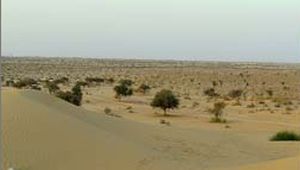 This is only 45 kms from the city on Jaipur Road, the village is rich in ethnic rural and cultural life. View sunset with typical desert landscape around, walk on a range of sand dunes and enjoy desert lifestyle. Villagers main profession is cattle rearing and milk production. The founder of Jasnathi sect of fire dancers- Jasnathji hail from this very place. Herds of chinkara, desert fox, rabbit, peacock, parrot and pat ridges are found in plenty around the village This is only 45 kms from the city on Jaipur Road, the village is rich in ethnic rural and cultural life. View sunset with typical desert landscape around, walk on a range of sand dunes and enjoy desert lifestyle. Villagers main profession is cattle rearing and milk production. The founder of Jasnathi sect of fire dancers- Jasnathji hail from this very place. Herds of chinkara, desert fox, rabbit, peacock, parrot and pat ridges are found in plenty around the village this village is also famous for its fire dancers, performing to the beat of drums on a bed of burning coals. |
|
Devi Kund |
Top^ |
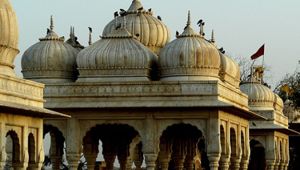 The Royal crematorium has several exquisite cenotaphs which were built in memory of the deceased members of the ruling family of Bikaner. The Chhatries (Cenotaphs) of the early rulers were made of red sandstone, ornamentation on which resembles very much with carving work on some of the buildings of Fatehpur Sikri.
There are cenotaphs (Chhatries) of 22 SATIES of royal family prior to Maharaja Gaj Sigh Ji (1745-1787). There is also one cenotaph of a SATA (male sati) of a ruler.The architecture of the cenotaphs is the prime attraction of this place. Maharaja Surat Singh's Chhatri is built entirely in white marble with spectacular Rajput paintings on its ceiling. Close by is a Dargah of Rustal Ali Shah Peer which is held in high esteem by muslim community and other people. |
|
Gajner Wildlife Sanctuary |
Top^ |
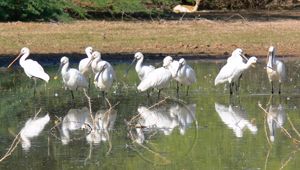 The Gajner Wildlife Sanctuary, Bikaner is one of the most prominent travel attractions in Bikaner. This sanctuary of wildlife is one of the most commonly visited places in the city. The Gajner Wildlife Sanctuary, Bikaner is one of the most prominent travel attractions in Bikaner. This sanctuary of wildlife is one of the most commonly visited places in the city.The Gajner Wildlife Sanctuary of Bikaner is situated about 32 kms away from Bikaner town. This place has a lot of historical importance. In the past, the Gajner Wildlife Sanctuary at Bikaner used to be a favorite site of hunting for Bikaner's Maharajah. It is here that the Maharajah has hunted a number of wild animals. The Gajner Wildlife Sanctuary at Bikaner is currently used in preserving a number of wild animals. |
|
The Camel Breeding Farm |
Top^ |
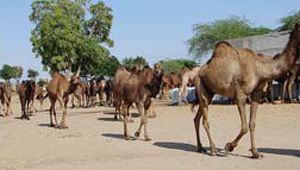 Bikaner-Camel Breeding Farm is one of the most preferred tours from Bikaner. The Camel Breeding Farm of Bikaner was founded by the Indian Council of Agricultural Research on July 1984. The Camel Breeding Farm is one of the largest camel farms of Asia and is located at Jorbeer, Bikaner. Bikaner-Camel Breeding Farm is one of the most preferred tours from Bikaner. The Camel Breeding Farm of Bikaner was founded by the Indian Council of Agricultural Research on July 1984. The Camel Breeding Farm is one of the largest camel farms of Asia and is located at Jorbeer, Bikaner. The Camel Breeding Farm of Bikaner, popularly known as Government Camel Breeding Farm, breeds the finest of camels in Bikaner. The Bikaner Camel Breeding Farm also conducts researches and experiments on the camels. The results obtained from the experiments are used to promote camel breeding. The Camel Breeding Farm in Bikaner employs the 'Raikas' or 'Rebars', local camel breeders, and aims towards making camel economically advantageous for the camel rearer of Bikaner. |
|
Kolyatji |
Top^ |
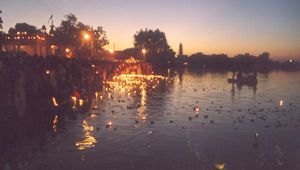 Kolyatji is a temple complex and a pilgrimage centre of Hindus. Located at 50 km from Bikaner, it is about an hour's distance in travel time. There are a number of temples, bathing hats and pavilions in the complex. The complex is built besides a lake and a dip in the lake on Kartik Poornima in November is considered auspicious. Kolyatji is a temple complex and a pilgrimage centre of Hindus. Located at 50 km from Bikaner, it is about an hour's distance in travel time. There are a number of temples, bathing hats and pavilions in the complex. The complex is built besides a lake and a dip in the lake on Kartik Poornima in November is considered auspicious.The importance of the temple lies in the legend associated with it. It is believed that Kapil Muni (a saint who advocated the Shankya yoga of the Hindu philosophy) while travelling towards northwest, was impressed by the serenity of this place and decided to perform tapasya (penance) here for the redemption of the world. |
|